Reading time: 10 min
This weekend, the Belgian Challenger Pro League will experience one of the most intense moments in its recent history. Three clubs – Zulte Waregem, RWDM and RAAL La Louvière – can still win promotion to the Jupiler Pro League, and everything will be decided on the final matchday. Between pressure, excitement, the weight of the past and a unique opportunity, the players will have to face much more than an opponent: their own minds.
A highly emotional context: three paths, three mental dynamics
A decisive match is never played in a psychological vacuum. It is always the continuation of a story, an expectation, a shared experience. For the players, it is not only the ball that weighs, but also accumulated hopes, recent memories, past frustrations and all eyes turned towards them.
RWDM – The pressure of not falling short again
In that respect, RWDM go into this final matchday in a delicate situation. Long-time leaders, the Brussels club seemed ideally placed to secure promotion. Yet a series of poor results, including a home defeat to Lommel, revived the spectre of failure. The pressure on the players' shoulders is immense: not to relive past disappointments. Mentally, the main difficulty lies in the fear of slipping up again. If this fear is not identified and channelled, it can cause a form of mental paralysis, inhibiting spontaneity and commitment. For the RWDM players, the challenge will be to turn this fear into a source of determination, remembering that the goal is to succeed, not to avoid failing.
Zulte Waregem – The weight of the label and home advantage
Zulte Waregem, for their part, approach this final showdown with a different kind of pressure: that of being expected to win. A club with a solid top-flight past, an experienced squad and playing at home against RWDM, Zulte have every structural advantage to clinch promotion. However, this situation creates a particular mental dynamic: the obligation to win. In this kind of configuration, the risk is tipping into over-control, trying too hard, which harms the flow of play. To avoid this, the team will need to reconnect with the enjoyment of playing and freedom of expression on the pitch, while channelling the energy of the crowd to make it an asset rather than extra pressure.
RAAL La Louvière – The surprise guest turned quiet favourite
Finally, RAAL La Louvière perhaps represent the most interesting mental dynamic. As a newly promoted side, they were not expected at this level. Yet they arrive at the final matchday masters of their own destiny: a win guarantees promotion and could even give them the title if their rivals draw. This situation cuts both ways. On the one hand, it brings legitimate confidence and positive emotional momentum; on the other, it can spark excessive excitement or even an unconscious fear of “ruining everything”. The challenge here will be to stay true to their playing identity, not to give in to projecting or anticipating the result, and to stay anchored in the present moment.
So on the eve of this decisive day, each club faces a distinct psychological context. RWDM must manage the memory of failure, Zulte Waregem the demand to succeed, and RAAL La Louvière the unique opportunity to rise without inhibition. Sporting success will therefore depend as much on mental clarity as on technical quality.
Channelling pressure to make it an ally
Before going into the detail of the psychological strategies that apply to this kind of decisive moment, it is essential to remember that high-stakes matches call on very specific mental resources. To face this kind of occasion, players must be ready not only physically and tactically, but also have real mental tools. That is why, in the following sections, we will explore several practical tips based on sport psychology to help athletes approach this kind of situation with calm, clarity and commitment.
First, we have to accept that in this kind of context, pressure is inevitable. It is even a sign that the stakes are real and that the moment matters. The mistake would be to try to run away from it or ignore it. The right approach is to accept it, name it and give it a constructive function. In sport psychology, this skill falls under emotional regulation: knowing how to welcome intense emotions, understand them and transform them into mobilising energy. Research on stress in sport shows that high-performing athletes don't feel less stress, but they are better at interpreting and channelling it.
For players, this involves emotional introspection. Identifying what you feel makes it easier to regulate. Taking a moment of conscious breathing, reminding yourself that “it's normal to feel this pressure”, and inwardly reframing this emotion as a sign of importance can help regain clarity. Techniques such as heart coherence or mindfulness, regularly used in mental preparation, help stabilise heart rate and improve decision-making under pressure.
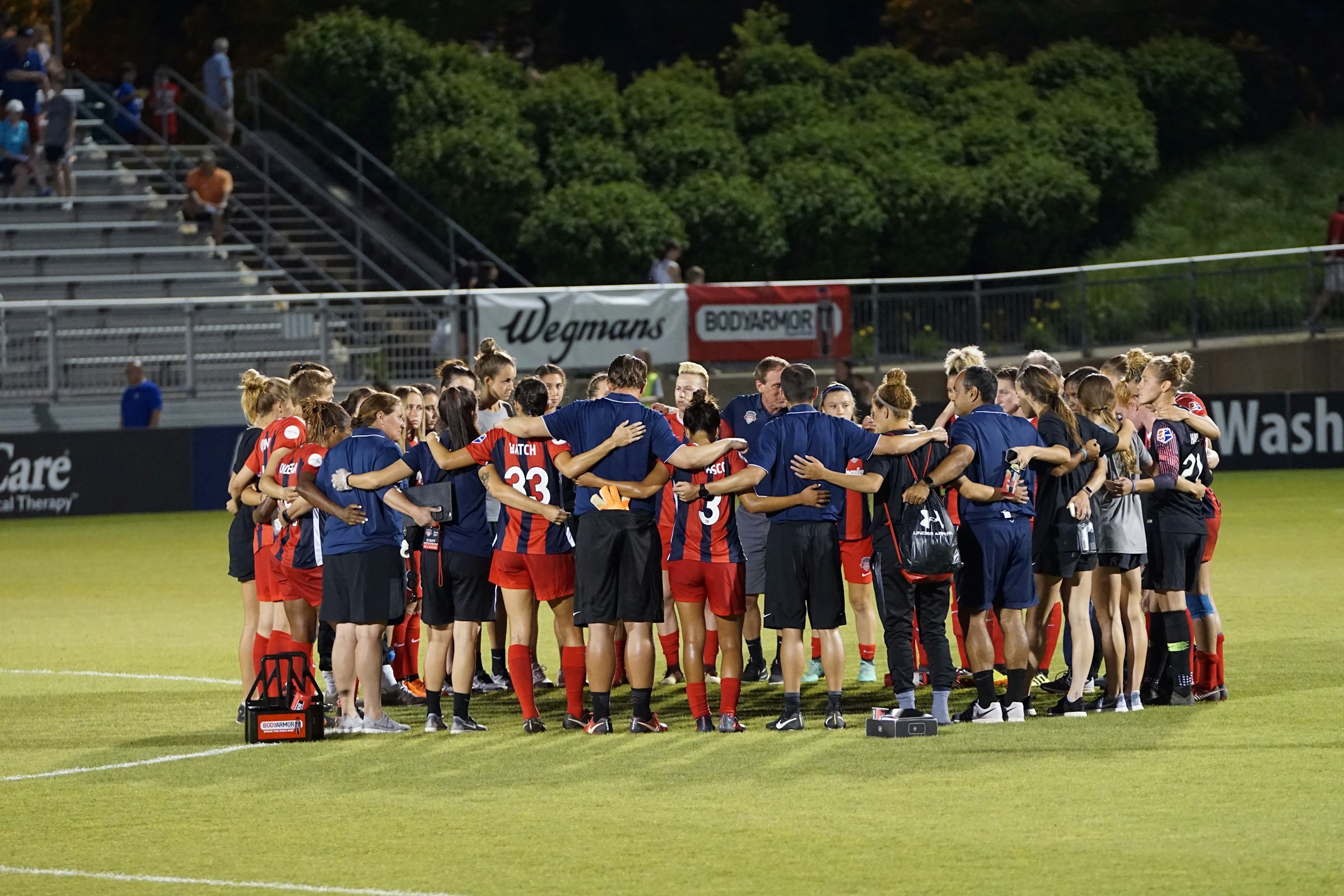
At team level, creating spaces to talk is essential. Sharing feelings with teammates reduces the individual emotional load and strengthens cohesion. A psychologically united team is better able to weather the emotional storms of a high-stakes match. The sport psychologist or coach can play a central role here by facilitating these exchanges and establishing a culture of listening and mutual support, based on psychological safety.
Anchoring in the present and visualising success
The temptation to project onto the consequences of the result is strong: promotion, the title, the celebrations or the disappointment. Yet this kind of thinking can interfere with concentration and increase performance anxiety. In sport psychology, this relates to the ability to stay in the “here and now”, a central concept in mindfulness applied to sport. The ideal is to come back to the present moment, to the game, to the immediate task. Setting performance goals – winning your duels, completing your passes, staying on the move – keeps you connected to the action rather than the result. This promotes activation of the so-called “process” mode, in which the brain works more fluidly, without cognitive overload.
Mental visualisation, or motor imagery, is also a scientifically validated strategy. The brain makes very little distinction between a vividly imagined action and one actually carried out. So imagining a successful pass, a won duel, a goal scored or a decisive intervention allows the brain to become familiar with these scenarios and optimise neuromuscular connections. This practice builds confidence, reduces stress and prepares the body for action.
At team level, visualising together the stages of a successful match can create a powerful shared dynamic. This can be done through a coach's talk, a team meeting with a projected scenario, or even a guided visualisation. This kind of group exercise strengthens cohesion and mental synchronisation, key elements of collective performance under pressure.
Pre-match routines also play a fundamental role in structuring the mind and preparing the body. Whether it is music, a gesture, a key phrase or a moment of calm, each player can build a bubble of stability amid the surrounding chaos. This routine anchors the mind and reduces inner agitation.
However, it is just as essential to prepare mentally for the unexpected: a mistake, a goal conceded, a frustrating refereeing decision. The goal isn't to eliminate mistakes, but to learn how to respond to them. To do this, each player can adopt a quick refocusing strategy: a gesture, a word, a breath. Collectively, establishing a culture of support after a mistake is crucial: remembering that it isn't the error that defines a player, but their reaction.
Staying connected to the enjoyment and intensity of the moment
Finally, we must never lose sight of the fact that football is above all a passion. Even amid the tension, it is possible – and desirable – to find enjoyment again. Smiling, celebrating together, looking each other in the eye with pride: these simple gestures reconnect us with what matters. A team that plays with heart, combining fighting spirit and joy, has every chance of performing well.
In sport psychology, the notion of enjoyment is linked to intrinsic motivation, the motivation that comes from within: the love of a challenge, the feeling of competence or the bond with teammates. When pressure becomes overwhelming, reconnecting with what makes you love the sport is a powerful lever to reduce anxiety and free up expression.
It has also been shown that positive emotions promote cognitive flexibility, creativity and quick decision-making – decisive assets at key moments of a match. So cultivating a positive atmosphere in the dressing room, in the tunnel or on the pitch can really improve individual and collective performance.
Before kick-off, a word, a phrase or a gesture can change a player's state of mind. At this level, everything sometimes comes down to the right emotion at the right time. In the end, it is by playing with enjoyment, with intensity but also with authenticity that you give your best, whatever is at stake.
Conclusion: turning the stakes into an opportunity
This Friday, the Challenger Pro League players won't just be playing a match. They will have the opportunity to make history for their club, do justice to their season and write an unforgettable page in their careers. Champions don't stand out only through their technical skills, but through their ability to perform under pressure. It is this psychological skill that turns a stressful situation into a lever for excellence.
Turning the stakes into an opportunity means adopting a proactive mental stance: not enduring pressure but channelling it; not fearing failure but seeking to express your potential. This requires high-quality mental preparation, but also a culture of surpassing yourself carried by the group.
Finally, it is important to stress that mental strength can't be decreed: it is cultivated. Through training, rituals and cohesion, but also through a genuine intention to grow. On this final matchday, it is that strength which will make the difference between those who play a match and those who write their names into history.
At Au Mental, we believe great performances are born in the head before they show on the pitch. Well-conducted mental preparation can make all the difference. Whether you are a player, coach or club official, remember: it is in adversity that champions reveal themselves.
Summary of our advice:
1. Understand the emotional context
- Each team faces a specific mental load :
- RWDM : managing the fear of failing again.
- Zulte Waregem : taming the obligation to win at home.
- RAAL : seizing an exceptional opportunity without rushing.
Key tip : identify the team's own mental dynamic to adapt emotional preparation and the collective message.
2. Channel pressure instead of running from it
- Accept pressure as a sign that the moment matters.
- Use validated techniques for emotional regulation (breathing, mindfulness, heart coherence).
- Establish a climate of trust and open conversation within the group.
Key tip : turn pressure into constructive energy, and create an environment of strong emotional support.
3. Stay anchored in the present and visualise success
- Avoid projecting onto the score or promotion; stay focused on immediate actions.
- Use mental visualisation to build confidence and brain-body coordination.
- Build a collective visualisation of the match to unite intentions.
Key tip : focus attention on the process, not the result, and prepare the brain for success through motor imagery.
4. Structure the pre-match period and prepare for the unexpected
- Develop stable routines to secure your mental state (gestures, music, affirmations).
- Anticipate mentally mistakes or setbacks and define refocusing strategies.
- Encourage a culture of reaction rather than blame.
Key tip : ritualise the pre-match period to gain stability and adopt a mental management plan for unexpected events.
5. Keep enjoyment and authenticity in the game
- Reconnect with intrinsic motivation (love of the game, bond with the group, feeling of competence).
- Cultivate positive emotions to improve creativity and decision-making.
- Protect the dressing-room atmosphere and the rituals that bring joy.
Key tip : enjoyment is not a luxury under pressure, it is a driver of performance.
6. Turn the stakes into an opportunity
- Adopt a proactive mental stance : face things rather than avoid them.
- Build a culture of surpassing yourself, carried by the collective will to make history.
- Work on mental strength as a trainable skill.
Key tip : mental excellence is built over time and revealed at key moments.
Read next