Reading time: 8 min
When a young athlete gets injured, it's not just their body that stops, their whole balance wobbles. Very quickly, the injury can trigger a central fear: losing their place. Afraid of losing their status, they put pressure on themselves to come back as fast as possible, stop listening to their body… and unfortunately increase the risk of re-injury. As a parent, you often find yourself juggling support and worry. In this article, we break down what an injury triggers mentally in a young person, what you go through in the background, and how to support them in the right way.
Case analysis
Yanis plays for a good club. He is serious, ambitious, and he has never really gone off “his path”. A starter most of the time, a good student in training, well liked in the dressing room. A player who is moving forward.
Then one day, after an intense match, Yanis gets injured.
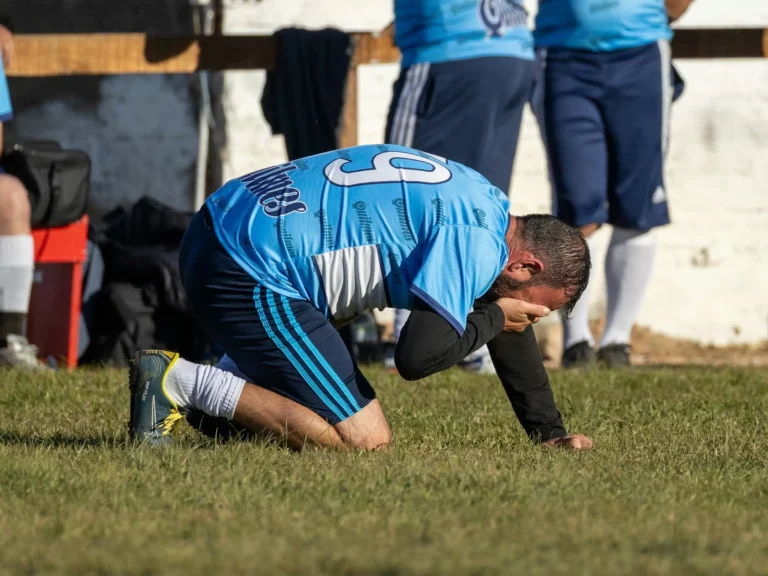
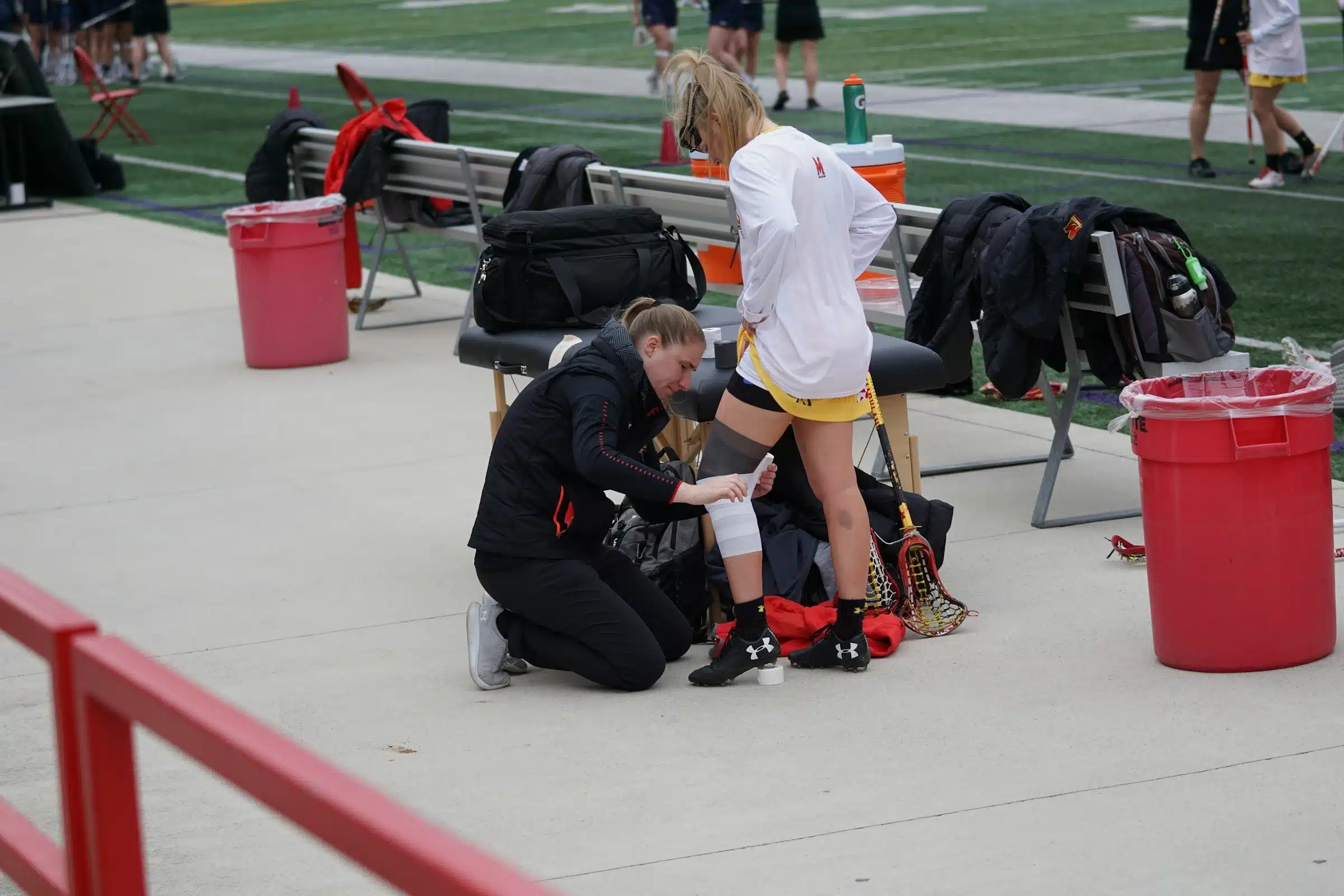
Your child takes a violent kick to the ankle. You can see straight away that it isn't minor: he cries out in pain on the pitch, he can't put his foot down, he is taken off and treated as an emergency. At the hospital, the diagnosis comes: a fracture, long immobilisation. The doctor announces three months in a cast, then rehab, and therefore a much longer break from sport than you imagined. Emotionally, he is extremely disappointed: disappointed in himself, disappointed that he can't play, frustrated at “letting down” the team and losing his rhythm. But very quickly another dimension appears: the matches go on without him, the team adapts, sometimes it wins, and he starts to feel less indispensable and, above all, sees his body change (muscle atrophy). It directly affects his mind and his self-esteem. He ruminates, doubts, compares himself, wonders whether he will be forgotten, whether his place is under threat, whether he will come back at the same level. And you notice concrete signs: loss of appetite, fatigue, irritability, lack of motivation, low mood, sometimes a form of disgust or withdrawal. It isn't “just” an injury: it is a rupture that affects his sporting identity, his reference points, his status in the group and his inner sense of security…
Coming back quickly to calm the anxiety
When your child gets injured, they don't just lose playing time. All at once, they lose what gave them a sense of stability: their routine, their visible progress, their presence in the group, the immediate recognition of the coach and teammates. Coming back too early is rarely a motivation problem. It is more a problem of interpretation. And in their head, injury very often activates three fears (Conroy, 2002). First, the fear of shame : “People will see that I'm fragile”, as if the injury exposed a flaw, as if it said something about them. Then the fear for status : “I'm going to lose my place”, the most common and the most insidious, fed by details that seem trivial but hit hard when you're sidelined: another player improving, the team carrying on without you, wins piling up. Finally, the fear for the relationship : “I'm going to disappoint”, because sometimes the pressure doesn't come from outside, it comes from an inner script. Your child imagines what is expected of them. They convince themselves they have to come back quickly to live up to it, for their parents, for their coach…
That's the trap.
Your child “manages” the pain instead of listening to it. They rush the stages and convince themselves they are ready because they no longer want to wait. And paradoxically, the more they come back with fear, the more the body stiffens. There will be less commitment in challenges, restrained movements, hesitant footwork, avoided contact, attention fixed on the injured area. By protecting the injured area, the body adopts a pain-avoiding gait and compensation mechanisms: one side is offloaded and the other overloaded. And if it lasts, it creates asymmetries in loading and musculoskeletal imbalances, with a risk of secondary pain or injuries. So you may see a comeback that “looks” brave but is in fact an attempt to reassure themselves through action: getting back to calm the anxiety.
And when the injury lasts, another phenomenon sets in: it becomes a story your child tells about themselves. “I'm behind.” “I'm missing my moment.” If it isn't reframed, this narrative becomes toxic: it attacks their identity, not just their ankle. And as a parent, you see it in daily life: mood drops, appetite decreases, irritability, opposition, lack of motivation, sometimes anger directed at you or at the world. So the real challenge is not to get back on the pitch quickly but to come back better, with a body that is ready and confidence that has been rebuilt.
The urge to perform
During an injury, many young people hold an automatic belief: “rest = wasted time” and “if I'm not progressing, I'm going backwards.” So they compare themselves, see others moving forward and feel they are losing ground. It isn't jealousy: it is mainly a fear for their status (being overtaken, losing their place), often accompanied by shame (“I'll come back worse, and it'll show”). As a result, they don't really recover; they fight against rest. The key work is to identify the rigid beliefs (“I must”, “I'm not allowed to slow down”) and reframe them: progress doesn't stop, it changes form (recovery, rehab, discipline, patience, mental strength). Slowing down at the right time is investing in a lasting comeback; it is a lesson, an experience that will become part of their story as an athlete.
How do you experience it, as the parent of an athlete?
We talk a lot about the injured athlete. But you, as a parent, experience the injury from the inside. First there is raw worry: the image of the scene, the pain, the hospital, the diagnosis, the break. Then comes a quieter disappointment, sometimes even hard to admit: you are disappointed for them, because you know everything they have invested, because you see their face close up, because you feel the injustice just when everything was going well. And deep down, there is often helplessness: you would like to take their pain away, speed up time, give them back their pitch and their enjoyment, but you can't. Then, when they start to return, you are not as “reassured” as you thought you would be: you become hypervigilant. You analyse how they walk, you scrutinise their reactions after training, you watch for the slightest sign of pain, and you mentally prepare for the worst. That is where many parents find themselves stuck in a difficult position. You constantly hesitate between pushing them to keep their spirits up, holding them back so they protect themselves, or letting them manage so as not to smother them… with the feeling that whatever you do, you might get it wrong. It isn't that you don't know how. It's that it's hard, because you are carrying two realities at once: their need to rebuild, and your fear that they will break again.

Worry, hypervigilance and the fear of getting it wrong
What complicates everything is that the return is not just medical. Your child can be “fixed” on paper and yet come back with a fear of contact, a lack of confidence, hesitation, over-control and anxiety about re-injury. And if nobody helps them through this stage, they may start playing again… without daring to play. That is often where the real relapse happens: not just a physical relapse, but a quieter mental one that damages risk-taking, enjoyment and freedom to play. That is also why parental support matters so much. Sport psychology research has long shown that social support and the quality of the environment are key factors in rehabilitation, adherence to rehab, confidence on return and emotional management during injury. In other words: your role does not replace the physio or the doctor, but it carries a lot of weight in how your child will experience, interpret and get through this period.
How can you support without adding pressure?
In practice, what really helps is not doing more, it's doing better. The first lever is to clearly separate your child's worth from their sporting status: they need to feel that their place in your relationship does not depend on their level, their selection or their performance. The second is to change the focus of your questions: if you keep asking “When are you playing again?”, you reinforce the urgency; if you ask “How is your recovery going?”, you reinforce their sense of control. The third is to normalise what they are going through without dramatising: yes, being afraid of contact, being frustrated, being angry is normal; vulnerability is not the opposite of mental strength, it is often the starting point of the rebound. And finally, the most powerful lever is to give them back things they can control: a clear path, stages, progressive goals. Confidence doesn't come back through motivation, it comes back through evidence. That is exactly where we work, in a structured way, with tools to restructure and deconstruct beliefs (“if I stop, I'll go backwards”, “I'm going to lose my place”), mental routines and return goals that secure the body as much as the mind.
That is precisely what we teach in AU MENTAL Academy. You will find a clear method to understand what an injury triggers mentally, avoid rushed comebacks driven by anxiety, and support your child in the right way.
Registration is open now: join AU MENTAL Academy via this link.
References
Conroy, D. E., Willow, J. P., & Metzler, J. N. (2002). Multidimensional fear of failure measurement: The Performance Failure Appraisal Inventory. Journal of Applied Sport Psychology, 14(2), 76–90. https://doi.org/10.1080/10413200252907752
Sagar, S. S., Lavallee, D., & Spray, C. M. (2007). Why young elite athletes fear failure: Consequences of failure. Journal of Sports Sciences, 25(11), 1171–1184. https://doi.org/10.1080/02640410601040093
Cox, R. H. (2012). Sport psychology: Concepts and applications (7th ed.). McGraw-Hill.
Read next