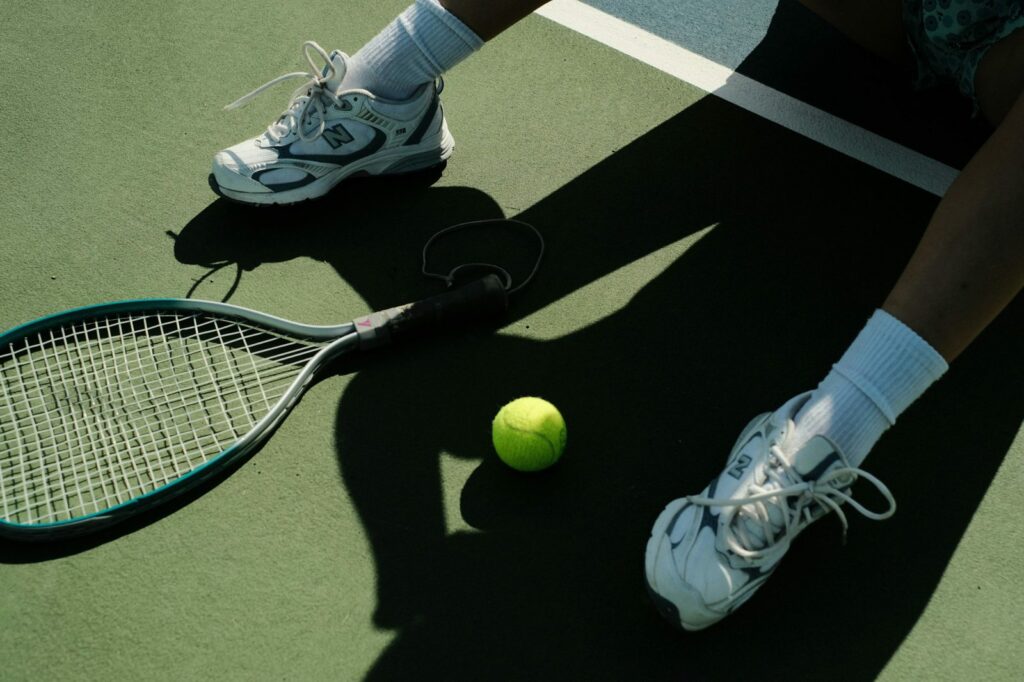
Inès is 14, with a real passion for tennis and big dreams. She is hard-working, organised and ambitious. But on court, one mistake could be enough to tip everything over. Here is how we are supporting her to keep her ambition, without every missed point becoming a mountain.
Who is Inès?
Inès has played tennis since she was very young. At school, everything is going well: good results, lots of friends, a real ease in connecting with people. She is also very independent for her age. She manages her bag, her schedule and her journeys without needing to be reminded.
Her dream is clear: to become a professional player. And she doesn't do things by halves.
What brought her to us
In matches, when Inès misses or does not reach the goal she had set herself, she can fall apart. Frustration rises, her game unravels, and sometimes she gives up completely. From the outside, it might look like a lack of fighting spirit. In reality, it is often the opposite: she cares so much about doing well that mistakes become unbearable.
What lies behind it
Tennis makes all this even more visible. It is an individual sport, where you face every mistake alone, with no teammate to share the weight.
Our support
The goal isn't to “break” her strength or her ambition. It is to make that strength more flexible.
Where Inès is today
In a short time, the changes are already clearly visible. The most striking: Inès stays in the match to the end. The frustration is still there, and that's normal, but she no longer gives up. She fights to the last point, which she didn't do before.
She also uses the tools we worked on together, and above all at the right moment: her routine between points, her anchor phrase, her frustration scale. Before every match and every training session, she sets her own goals, and she achieves them. She also dares to assert herself more, on court and off it.
Her mum sums it up simply: in such a short time, her daughter has changed a lot. Today she describes her as determined.
The support continues. The next step: consolidating this progress in high-stakes matches, where the pressure is strongest. Because the habit of judging yourself so harshly doesn't change in a few weeks, but you can learn, point after point, to trust yourself more.
What the science says
- Perfectionism has two faces in sport. Aiming high can help. But fear of mistakes and self-criticism are associated with more anxiety and a risk of burnout (Hill et al., 2018).
- Routines before and between actions help athletes refocus and regulate their emotions under pressure (Cotterill, 2010).
- Parents play a key role in young tennis players' experience: support focused on effort and enjoyment, rather than results, makes matches calmer (Knight & Holt, 2014).
References
Cotterill, S. (2010). Pre-performance routines in sport: Current understanding and future directions. International Review of Sport and Exercise Psychology, 3(2), 132–153.
Hill, A. P., Mallinson-Howard, S. H., & Jowett, G. E. (2018). Multidimensional perfectionism in sport: A meta-analytical review. Sport, Exercise, and Performance Psychology, 7(3), 235–270.
Knight, C. J., & Holt, N. L. (2014). Parenting in youth tennis: Understanding and enhancing children’s experiences. Psychology of Sport and Exercise, 15(2), 155–164.
Case study written by Emiram Joseph, AU MENTAL. The athlete's first name and several details of this story have been changed to protect the anonymity of the athlete and her family. It is published with their consent.