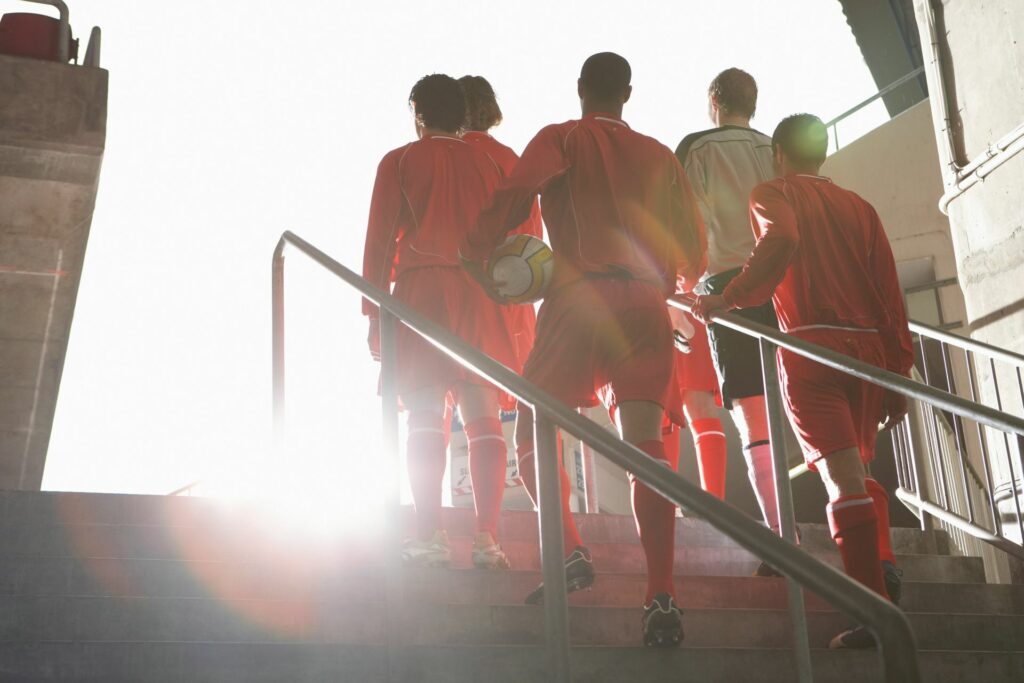
At 20, Franz had already achieved the dream of many young footballers: signing a professional contract. Yet he found it hard to believe he really deserved his place.
Between physical setbacks, fear of disappointing and a constant need to prove his worth, his path was marked by pressure he put on himself.
Here is how we supported him to recognise his qualities, regain confidence and build his progress, until he became a first-team player at his club in the Belgian First Division.
Who is Franz?
Franz, 21, is a Belgian defender playing in the First Division. Fast, strong in duels and able to break lines with the ball at his feet, he has gradually made his way in professional football thanks to his qualities and his work.
When we started working with him in early 2025, Franz was moving between the U23s and the first team. He already had a professional contract but was going through a difficult period, marked in particular by physical setbacks that kept him off the pitch for several months.
Beyond these physical setbacks, Franz faced a less visible difficulty: he struggled to recognise his own worth.
What brought him to us
When we met Franz, he found it hard to recognise his own successes, even signing his professional contract.
He tended to think opportunities had been given to him rather than earned. His satisfaction depended heavily on other people's reactions. If those around him recognised a success, it gained value in his eyes. Otherwise, he could see it as something ordinary.
On the pitch, this dependence on outside opinion was particularly strong. When he missed a cross or a pass, he would sometimes immediately look for his teammates' reaction. A sign of disappointment could be enough to unsettle him and affect the rest of his performance.
This period away from the pitch heightened these difficulties. He also felt the need to come back quickly to show he deserved his contract.
Several times, this wish to meet outside expectations pushed him to want to speed up his return.
Franz wasn't just afraid of losing his place. He was afraid of disappointing those who had placed their trust in him.
What lies behind it
All these elements ended up coming together: for Franz, playing well was no longer just about expressing his qualities, but also about reassuring others of his worth.
Our support
Our goal was not to reduce his ambition. It was to help him build confidence that depends less on results, status and outside opinion.
The common thread of this support was simple: helping him regain control of what really depends on him.
Where is Franz today?
The first changes showed in the way he approached training, mistakes and other people's expectations.
A few months later, Franz explained in particular that he felt less stress when he joined up with the first team. Where he had previously feared the judgement of his teammates and coaches, he began to focus more on his own standards and on his football.
He also noticed that the goals worked on in training helped him maintain his concentration and discipline.
After this period away from the pitch, he gradually returned to competition with the reserves, then got his first minutes with the first team in a cup match.
The work then continued on consistency, communication, leadership and keeping up his routines, including when circumstances were less favourable.
Franz finished the 2025-2026 season on a positive note before starting the 2026-2027 season with his club's first team.
At 21, he now plays in the Belgian First Division and already has five league starts (October 2026), after coming through the U23s in Division 4.
His progress isn't just about this change of level. Franz gradually learned to better recognise his achievements, to take more distance from what others think, to respect the stages of his recovery and to set goals he can act on.
The support helped give him reference points he can keep drawing on in the different situations of his career.
Because the real challenge wasn't just getting back into the first team. It was learning to feel legitimate, even when he wasn't in it.
What the science says
- Returning from injury doesn't depend on the body alone. A systematic review shows that confidence, motivation and fear of re-injury are associated with returning to sport after an injury. Psychological recovery therefore deserves as much attention as physical preparation (Ardern et al., 2013).
- The way athletes talk to themselves influences their performance. A meta-analysis of 32 studies shows that interventions focused on inner dialogue can improve sporting performance. Learning to talk to yourself constructively is a relevant lever for handling mistakes better (Hatzigeorgiadis et al., 2011).
- Autonomy and a sense of competence are essential to motivation. Self-determination theory highlights the importance of three psychological needs: autonomy, competence and relatedness. Meeting them encourages more autonomous motivation and well-being, as opposed to functioning mainly driven by outside pressures (Ryan & Deci, 2000).
References
Ardern, C. L., Taylor, N. F., Feller, J. A., & Webster, K. E. (2013). A systematic review of the psychological factors associated with returning to sport following injury. British Journal of Sports Medicine, 47(17), 1120–1126. https://doi.org/10.1136/bjsports-2012-091203
Hatzigeorgiadis, A., Zourbanos, N., Galanis, E., & Theodorakis, Y. (2011). Self-talk and sports performance: A meta-analysis. Perspectives on Psychological Science, 6(4), 348–356. https://doi.org/10.1177/1745691611413136
Ryan, R. M., & Deci, E. L. (2000). Self-determination theory and the facilitation of intrinsic motivation, social development, and well-being. American Psychologist, 55(1), 68–78. https://doi.org/10.1037/0003-066X.55.1.68
Case study written by Andy Kawaya, mental coach at AU MENTAL. Published with the athlete's consent.