Reading time: 4 min
Are you the parent of a promising young footballer or athlete, but not always sure how best to support them? You are not alone… Over our years of mental preparation work with young athletes, one thing has become obvious to us: parents have a huge impact on the progress, or the pressure, their children experience. Often driven by love and the desire to do the right thing, these parents nevertheless make mistakes that hold back their young athlete's mental and emotional development.
Here are the 3 most common mistakes we see in parents… and how you can cleverly avoid them.
Mistake 1: Confusing a child with a mini-adult
– Common mistake: thinking your child reasons, handles pressure or understands sport like an adult.
A child's or teenager's brain is not wired to handle performance stakes like an adult's. High standards, strategy, emotional distance… these are learned gradually, provided the climate feels safe.
Some parents wonder why their young champion doesn't yet have the rigour, discipline and determination of an accomplished professional athlete. The answer is simple: these mental skills are acquired over time, through positive and negative experiences, failures and life lessons. Things we have already lived through as adults but that we don't always give our children time to experience. That is where mental preparation for young athletes comes in.
The right reflex: adapt what you say to their mental age, not their technical level. Ask open questions (“why?”, “for what reason?” are very powerful questions), encourage more than you correct, and remind them that failure is the path to success.

I used to do everything for my son. Thanks to AU MENTAL, I learned to let go and give him more responsibility. It completely changed the dynamic at home, as well as his performance on the pitch.
Hajar, mother of a young U11 footballer
Listen to her full testimonial !
Mistake 2: Thinking pressure makes them progress
– Common mistake: focusing too much on results, rankings and stats. And passing that pressure on to your child.
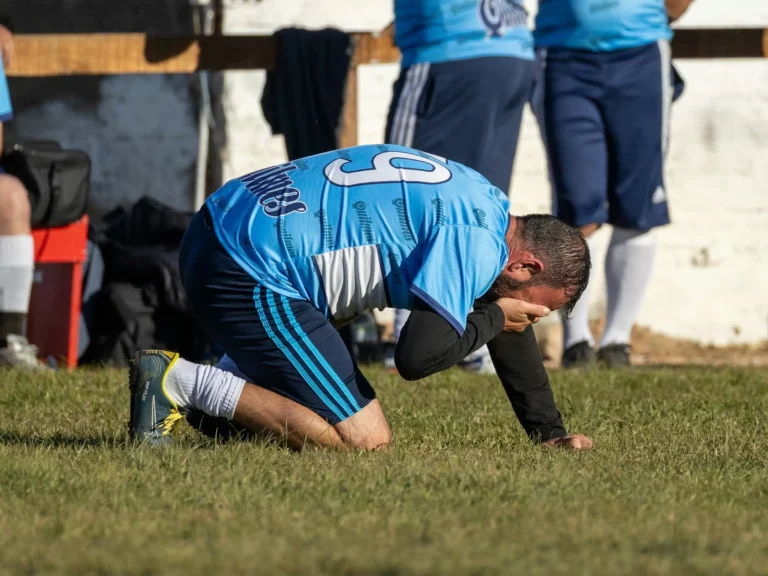
Performance is born of confidence, not fear. A child who feels they are playing to “validate” their parent, or to avoid disappointing them, plays less freely, less instinctively. Their “thinking” brain blocks their “intuitive” brain, which harms their performance.
We all know a young prodigy who is excellent in training but invisible in competition. It can come from an unintentional mistake by the parents: pressure.
The right reflex: value effort, progress and enjoyment over results. Be a reference point, not a judge. Your role: create a stable, reassuring framework where your child feels free to dare and feels valued unconditionally.
Mistake 3: Skipping stages of sporting development
– Common mistake: piling on training sessions, camps and competitions… without listening to the child's deeper needs.
At AU MENTAL, we believe that before the age of 13, a young athlete is in a phase of discovery, learning and fun. Youth sport is not supposed to mean constant stress and fatigue.
Early acceleration and overload can generate mental and physical fatigue, and even disgust. A child who “endures” their sporting schedule risks dropping out or getting injured… sometimes for a long time.
That is why, by adolescence, some athletes suffer from mental exhaustion and sometimes pre-burnout. Mental support for the parents of young athletes and for their children helps avoid these situations.
The right reflex: listen to their signals. Vary the activities. Encourage rest. Give them time to be a child, to breathe, to be bored, to play freely and have fun. The long term matters more than results at age 10.

Conclusion
Parents are their children’s first coaches. Parents play a fundamental role in a young athlete’s career. Mental coaching for athletes and their parents leads to better support, a more balanced stance and stronger backing. Parents contribute directly to their child’s development and lasting success.
Discover the inspiring testimony of Hajar, an athlete’s mother who transformed her relationship with her son thanks to our support.
Coming soon: launch of the Mental Preparation Academy – September 2025
We will soon be opening an Academy dedicated to the mental preparation of young athletes… and their parents.
🔔 Registration for the Academy waiting list will open soon!
🎓 A unique course, designed for parents and young athletes.
Joël Odi – Mental coach, psychology graduate
Bibliography
- Christine M. Habeeb, Jordan Barbee, Thomas D. Raedeke (2022). Association of parent, coach, and peer motivational climate with high school athlete burnout and engagement: Comparing mediation and moderation models. Psychology of Sport and Exercise vol. 68
- Katherine A. Tamminen, Nicholas L. Holt (2012). Adolescent athletes’ learning about coping and the roles of parents and coaches. Psychology of Sport and Exercise vol. 13
Read next